
Five Finance Solutions That Can Support Startups Today
One of the biggest challenges that climate tech startups face is that there is no single funding source that can support a company from idea to commercialization.
Startup founders may breathe a sigh of relief as they reach the post-pilot stage, but it’s at this stage where they must manage a rapidly ballooning list of new expenses. Companies at this stage often start to need additional resources such as grants, working capital, equipment & project financing, infrastructure capital, insurance products, legal support, and strategic partnerships at different stages of growth.
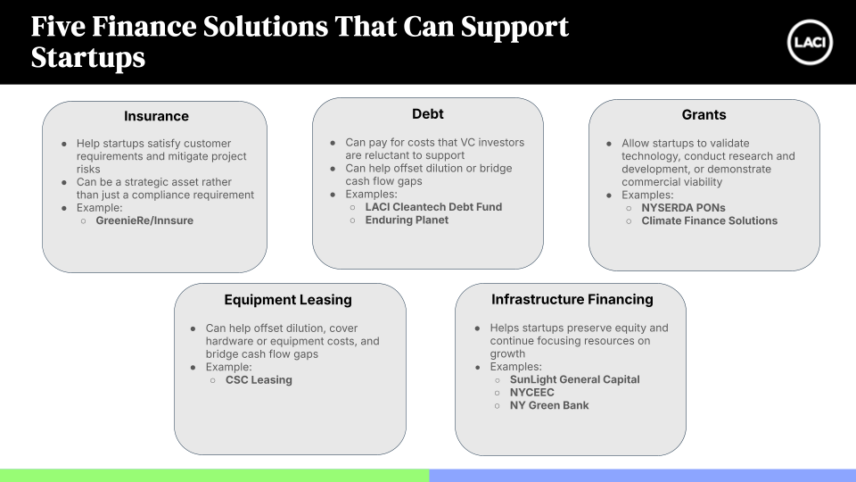
Startups met in early June at BATWorks in Brooklyn to discuss the hybrid of financing solutions that are often necessary to help emerging companies scale their businesses. Attendees walked away with a better understanding of five key financing options beyond venture.
Debt for Customer Financing and Working Capital
A few reasons why debt is special – not only does it avoid dilution and help extend runway, but it can help pay for costs that VC investors are reluctant to support, such as hardware or working capital. LACI has its own LACI Cleantech Debt Fund, which has deployed $7.8 million across 40 loans.
Of the startups that are recipients of the Debt Fund, Idle Smart, a fleet management company, received $250,000 to support the company through supply chain delays.
After slowing down deployment to fine tune their smart energy management product, Community Energy Labs received $250,000 to fulfill their backlog of commercial contracts.
Lastly, Tyfast Energy, an advanced battery manufacturing company, received multiple loans totaling $600,000 to finance reimbursable government grant projects, showing just the variety of ways debt can support a growing business.
Equipment Leasing
For startups that need access to critical equipment, leasing is a great solution because founders do not have to make large upfront capital expenditures. Cleantech capital expenditures can add up, from manufacturing products, to deploying pilots, and serving customers. Equipment leasing helps extend runway for hiring, customer acquisition, and product development while avoiding early dilution.
Equipment leaser CSC Leasing provided a $50,000 piece of equipment to an early stage startup that develops solid refrigerants for next-generation energy-efficient heating and cooling systems. This startup was too early-stage to leverage traditional funding options and was able to avoid purchasing equipment that could have strained cash flow and growth early on.
Infrastructure Financing
Infrastructure capital can also support deployment of customer projects while allowing startups to preserve equity and continue focusing resources on growth. Sunlight General Capital, alongside Working Power and UPROSE, co-developed a 725kW community-owned and operated solar grid at the Brooklyn Army Terminal. The project cost $2.6 million and will provide bill savings to 200 households as well as a community wealth fund generated by revenue from the solar array.
Grants
Grants are often the first source of capital that allow startups to validate technology, conduct research and development, or demonstrate commercial viability. NYSERDA regularly provides funding opportunities through Program Opportunity Notices (PONs) to meet current projects with technical, economic, and environmental goals. NYSERDA PONs often require a site host for funding, and BATWorks serves not only as a site host, but it is one of multiple locations in New York that is registered as an Innovation Demonstration Site host.
Insurance
Insurance can help startups satisfy customer requirements and mitigate project risks. It can also be a strategic asset rather than just a compliance requirement. InnSure manages the recently launched Decarbonization Risk Management Prize that will award at least three early- to growth-stage companies with demonstrated technology capability up to $200,000 each in non-dilutive funding to develop and deploy data-powered underwriting solutions for emerging clean energy projects. Winners will also receive 12 months of hands-on acceleration support through InnSure’s Creation Labs program, which fosters the development of new climate risk management products and accelerates their go-to-market time.
The Real Unlock
The real unlock, as attendees saw firsthand, is learning how to layer these tools strategically. Take Wells Fargo and Bloom Energy. Bloom, a company that designs and manufactures solid oxide fuel cells, was able to receive helpful financial support from Wells Fargo through the following ways.
First, the relationship between Bloom and Wells Fargo was long standing – they worked their way up to the large deal over time, showing the importance of fostering investor relationships early, even when founders may feel like they’re not at the stage yet to meet with certain financiers. Second, they used a revolving line of credit, which is hard to find at early stages but can help reduce the cost of capital by not drawing down large sums of money before they are needed. Lastly, Bloom and Wells Fargo had a syndicated deal. While one lender may say no to a large check, others may be interested in coming in and augmenting the total available capital. The key takeaway isn’t just about access to capital, it’s about starting conversations before founders are ready for them.
Attendees at the June 4 Financing the Full Capital Stack Summit have a better sense of their financing options – now it’s time to dive into corporate contracts. Save the date for our third Climate Scaling Summit, Beyond the Pilot: Securing Corporate Adoption, on September 22 where we will discuss how to secure customer uptake with corporate entities following pilot deployment, including regulatory navigation and securing policy changes.
Register here: events.laincubator.org/cwnyc26-beyond-pilot-corporate-adoption/1