Scaling startups…sustainably: Avoiding the pitfalls of post-pilot stage growth
Few things are as rewarding for a hardware founder as turning a customer pilot into a large number of orders, or turning that customer traction into investment to scale the business. For founders that have worked for years to get through multiple valleys of death, moments like these can make it feel like success is now all but guaranteed.
And while many startups don’t ever make it this far, the challenges in scaling after the pilot stage can be daunting, whether you’re a self-funded small business or venture backed startup. Being aware of the most common pitfalls and building a corresponding plan is vital. To continue to climb where many will fail, leaders of highly-effective hardware startups should pay particular attention to three key areas: the pace of manufacturing expansion, designing for equity-enhancing industrial jobs and hiring, and managing working capital with customers and suppliers.
Keep reading for an overview on how to overcome these common pitfalls, and join LACI climate programs at BATWorks and SecondMuse for an in-person conversation at BATWorks in Brooklyn on March 31, 2026 to hear from experts directly about how to solve these challenges. Register here.
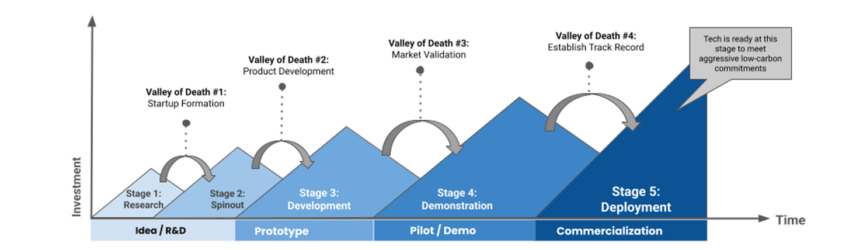
Figure 1: Climate Tech’s Valleys of Death. In moving through the Demonstration to Deployment stage, new challenges emerge in manufacturing, hiring and workforce capital management. Source: Rocky Mountain Institute; Greentech Media
Fortunately, there are programs out there to help you along the way as you navigate these three critical topics, including LACI’s own startup programming. For example, in thinking through how to tackle sustainable production, textbooks talk about moving from prototype to serial production as though doing so involves a simple formula, but the actual transition between the two usually involves a delicate series of steps. As many successful founders can attest, the first several dozen sellable units might be handbuilt before moving on to contract manufacturing and ultimately deciding to in-house production in a dedicated facility. Successful founders avoid the temptation to blitz-scale production and instead ensure that steadily growing production grows over time from more of an operating cost approach (i.e., handbuilt sellable units) to more of a capital heavy approach (i.e., in-house production). Along the way, tapping into a wide variety of prototyping centers – such as Maker Space NYC or the Advanced Prototyping Center at LACI’s campus in downtown LA, and contract manufacturers – is likely going to be key as founders learn to balance the need to quickly enter production to deliver against pilots or first customer contracts, while maintaining the ability to deliver on-time with strong quality and cost controls in place.
One of the least talked about, but most substantial challenges founders face, is learning how to hire thoughtfully to attract and retain talent, in addition to customers and investors. To hire for growth in the manufacturing, technical and industrial part of the business, it is key to consider designing not just for job quantity, but for climate equity and economic opportunity. Successful founders recognize the vital importance of attracting and retaining talent via strong wages and approaches like Employee Stock Ownership Plans (ESOP) while creating creating economic opportunities for local, underrepresented, underserved communitiesIn parallel, to create a better company that attracts and retains investors and customers, resources like LACI’s Impact Framework help founders manifest values via specific actions to deliver social and economic impact. Additionally, at this stage, as the company frequently grows into double digit headcount, successful founders often build genuine partnerships with workforce development operators to find and train the type of manufacturing, installation and operations and maintenance talent that drives long-term growth.
Now, let’s talk about the capital stack. We often see founders asking us how to manage working capital as the company starts booking real revenue and incurring new manufacturing-related costs. Prior to the production stage, the financial process had generally been taking investor money and stretching it to cover salaries and product development. But in this post-pilot stage, the startup begins to take on much-needed customer revenue while also managing a rapidly ballooning cost base from both new headcount and a large amount of work in process and a growing network of suppliers. This is when venture-backed startups need to learn about the full capital stack beyond venture, including green lending, equipment leasing and factoring. Resources like the first of its kind LACI Cleantech Debt Fund available to support working capital needs for climate startups across the nation, including in New York through incubator partners like The Clean Fight and Second Muse Scale for Climate Tech. It’s common here for startups to learn that certain customer promises around contracts aren’t going to materialize, or the harsh reality that one misstep from a supplier can mean several months of delay in getting a product shipped. Smart founders know that they are balancing accounts payable and accounts receivable in order to avoid running out of cash in the bank.
This post-pilot scaling phase is when the company has the opportunity to reach growth targets that create widespread economic, environmental and social impact. Keeping focused attention on these three interlinked issues of manufacturing, hiring and working capital, including with partners, is what will create an enduring business with loyal customers, committed employees, and satisfied investors.
Interested in learning more? On Tuesday, March 31, 2026 at 3pm ET, LACI climate programs at BATWorks and Second Muse will host a market-making event in Brooklyn that will dive deeper into time-tested tactics to scale startups sustainably. Startup founders can meet growth-stage partners such as contract manufacturers and workforce partners. Register here today.